How Laminated Nonwoven Fabric Improves Packaging Performance
September 14, 2026
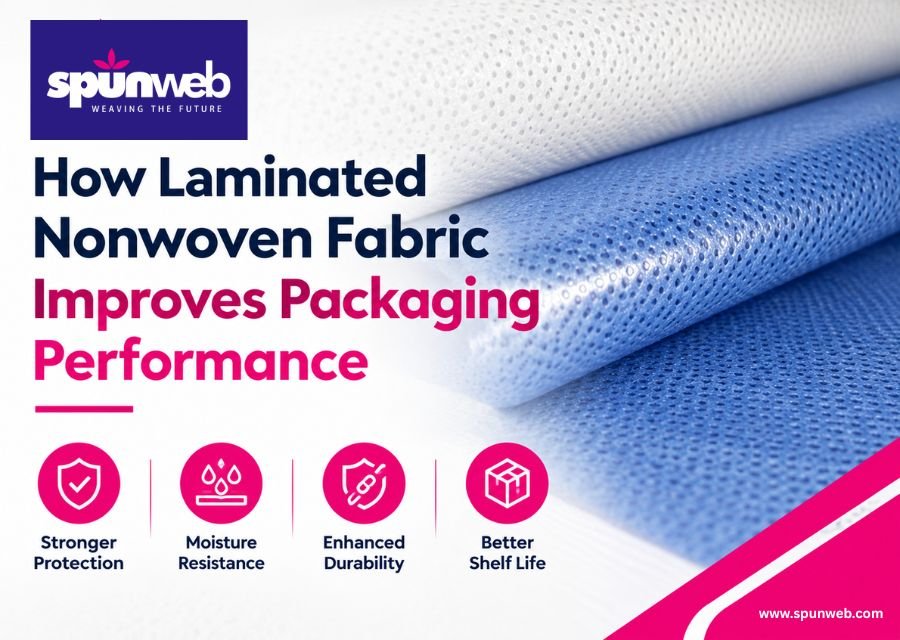
The modern-day requirement is that the packaging material should offer all these characteristics in one material. Nonwoven fabrics perform well mechanically but need extra protection if there is any chance of contact with water, dust, or rough handling of the material.
In such cases, for nonwoven fabric manufacturers in India like Spunweb, the concept of laminated nonwoven fabric becomes highly relevant. Here, the polypropylene nonwoven fabric is combined with a functional film or coating material to produce special packaging structures.
What Makes Laminated Nonwoven Different?
Laminated nonwoven fabric consists of a nonwoven base layer bonded with another material, commonly a polymer film. The nonwoven contributes structural strength and flexibility, while the laminated layer enhances barrier or surface properties.
| Property | Standard Nonwoven | Laminated Nonwoven |
| Tensile strength | High | High, depending on construction |
| Moisture resistance | Limited | Enhanced |
| Dust protection | Moderate | Higher |
| Surface protection | Basic | Improved |
| Printability | Good with suitable treatment | Can offer enhanced surface options |
| Application flexibility | Wide | Suitable for more demanding packaging |
The actual performance depends on GSM, substrate structure, film characteristics, bonding strength, and end-use conditions.
- Enhanced Moisture and Barrier Protection:
One of the biggest advantages of lamination is improved resistance to external moisture.
For packaging transported through humid environments or stored for extended periods, moisture can affect both the packaging and the product inside. A suitable laminated layer acts as an additional protective barrier.
| Packaging Requirement | Contribution of Lamination |
| Water resistance | Reduces penetration of external moisture |
| Humidity protection | Adds a functional barrier layer |
| Dust protection | Creates a more enclosed surface |
| Product integrity | Helps maintain packaging protection during storage |
This makes laminated structures particularly useful where environmental exposure is a critical packaging consideration.
- Improved Mechanical Performance:
Packaging goes through multiple stress points—from converting and filling to stacking, loading, and transportation.
A polypropylene spunbond substrate offers a strong and flexible foundation. When combined with an appropriate laminated layer, the overall structure can provide improved resistance to handling-related stresses.
For technical buyers, important parameters include:
- MD and CD tensile strength
- Elongation
- Tear resistance
- Lamination bond strength
- Dimensional stability
Rather than selecting fabric only on GSM, packaging non-woven fabric suppliers should evaluate these parameters according to the intended application.
- Better Surface Functionality and Branding:
Lamination can also modify the surface characteristics of nonwoven fabric. Depending on the film and finishing technology, manufacturers can achieve a surface suitable for printing, graphics, sealing, or improved appearance.
| Surface Requirement | Potential Advantage |
| Product branding | Suitable surface for graphics and printing |
| Heat sealing | Supports compatible sealing processes |
| Surface durability | Better resistance to abrasion |
| Appearance | Smoother and more uniform finish |
This is particularly relevant for retail, promotional, and industrial packaging where functionality and presentation need to work together.
- Packaging Performance Depends on Material Selection:
Not every laminated nonwoven structure is suitable for every application. The right combination should be selected based on product sensitivity, transportation conditions, and converting requirements.
Key factors to evaluate:
- Substrate: PP spunbond structure and GSM
- Barrier: Required moisture or environmental resistance
- Processing: Sealing, cutting, stitching or converting requirements
- Performance: Tensile, tear, and elongation characteristics
- Application: Retail, industrial, agricultural or specialised packaging
This specification-led approach helps businesses avoid over-engineering the material while ensuring the required performance.
Where Can Laminated Nonwoven Be Used?
Its combination of strength and enhanced protection makes laminated nonwoven suitable for several packaging environments.
| Application | Why Laminated Nonwoven Helps | Uses |
| Retail packaging | Surface quality and branding | Heavy-duty shopping bags, retail gift bags |
| Agricultural packaging | Added environmental protection | Crop protection covers, thermal insulation, blankets & greenhouse shading materials |
| Protective covers | Moisture and dust resistance | Chemical-resistant or waterproof covers |
| Specialised packaging | Customizable performance properties | Weather-resistant house wraps, mattress covers |
Spunweb – Your Trusted Partner:
Just as selecting the correct Non-Woven Fabric is essential, so is selecting the correct suppliers of the Non-Woven Fabrics. Spunweb offers extensive production of polypropylene spunbonds along with quality processes and experience across many industries.
Spunweb can handle high-volume production with its production capacity of over 39,000 MT per year, ISO 9001:2015 process certified, and exporting to more than 15 countries.
For any organization looking at Non-Woven Fabric Manufacturers in India, Spunweb continues to concentrate on offering reliable and application-based fabrics.
Best Non-Woven Fabric Manufacturers/Suppliers in India – Spunweb:
Laminated nonwoven fabric extends the functional capabilities of traditional nonwoven by combining mechanical strength with enhanced barrier and surface properties. The right structure, however, must be selected according to actual packaging conditions and processing requirements. For businesses seeking technically consistent solutions, partnering with an experienced Non-Woven Fabric Supplier like Spunweb can make a significant difference in packaging performance and reliability.
Frequently Asked Questions:
- Can laminated nonwoven fabric be customized?
Yes. GSM, dimensions, lamination structure, and surface finish can be customized as per application needs. - Where should laminated nonwoven fabric be stored?
It should be stored in a clean, dry, and well-ventilated place away from any direct source of sunlight, moisture, or heat. - Which sectors purchase laminated nonwoven fabric in large quantities?
They include packaging, agricultural, healthcare, hygiene, retail, and industrial sectors. - Why is manufacturing capacity important for bulk orders?
It helps ensure consistent quality, timely production, and uninterrupted material supply. - What should you check before choosing a supplier?
Consider product consistency, lamination quality, customization, production capacity and supply reliability.
Fill the form

For quick support on

scan QR code